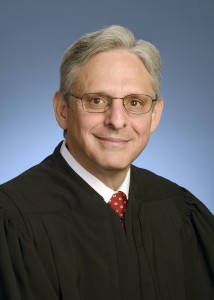
Merrick B. Garland is Obama’s latest pick for the Supreme Court. (AFRO File Photo)
District leaders appear to be cautiously supportive of President Obama’s selection of the chief judge of the U.S. Court of Appeals-District of Columbia Circuit to the U.S. Supreme Court. On March 16, President Obama tapped Merrick Garland to be the next jurist to sit on the Supreme Court. D.C. Mayor Muriel Bowser (D) attended the White House announcement ceremony and said that Garland should have a chance to air his views.
“As chief judge of the U.S. Court of Appeals, Judge Garland has served ably here in the District of Columbia and has earned respect that transcends party and politics,” Bowser said. “I stand with the president and I urge the Congress to move Judge Garland forward through a fair and judicious process. Just like the residents of the District of Columbia, Judge Garland deserves a vote in the Congress.”
Garland, a valedictorian graduate of Harvard College and a magna cum laude alumnus of Harvard Law School, has served on the District’s federal appeals court since 1997. Despite his stellar credentials, U.S. Sen. Mitch McConnell (R-Ky.), majority leader of the Senate, said there will be no consideration of an Obama appointee to the court this year.
D.C. Del. Eleanor Holmes Norton (D), a nationally recognized constitutional law scholar and professor at Georgetown University Law Center since 1982, told a meeting of the Ward 8 Democrats on March 19 that she is reviewing Garland’s credentials. “The chairman of the Congressional Black Caucus has appointed me to look into all Supreme Court and Court of Appeals vacancies,” Norton said. However, the delegate did express a sentiment that many Black women have about the Garland selection.
“Maybe I was naïve but I saw this vacancy as the last clear chance to sit an African-American woman on the court,” she said. “The African American on the court is a man, Justice Clarence Thomas and he is bad. He is there to vote against us and he has never been on our side.”
Faye Williams, president and CEO of the National Congress of Black Women, echoed Norton on Obama not picking a Black female for the Supreme Court. “I am disappointed but not angry,” Williams told the AFRO. “I didn’t want a Black woman to be battered and bruised during the confirmation process. When a Black woman is appointed to the Supreme Court, I want her to be confirmed.”
Williams agreed with Norton on Thomas, saying, “We have three women on the Supreme Court that we as Blacks can depend more than the one Black male.”
Kristen Clarke, the president and executive director of the District-based Lawyers’ Committee for Civil Rights Under Law, said, “This pick doesn’t contribute to the diversity of the court.”
Clarke made her remarks on a conference call with reporters on March 17, later crediting the president for his emphasis on diversity in the federal court. Clarke said that Obama has picked 77 Black federal judges as opposed to President George W. Bush with 24.
The CBC as a whole will likely follow Norton’s lead on the Garland nomination and will look to her research to reach its conclusion regarding the level of support to give.
Norton said Garland can’t be easily pegged as a liberal or conservative because “there are no hot-button issues” to judge him on. “The president has appointed a man nobody can tell where he stands,” she said. “We don’t know how he would rule on another voting rights case.”
Norton did take issue with Garland on a case regarding the District’s vote in the U.S. House of Representative, Alexander vs. Daley, in 2000. Garland wrote the majority opinion that said, in essence, the U.S. Congress, not the federal judiciary, has the power to determine whether District residents are entitled to voting representation in Congress.
Norton said that Obama “did the safe thing” by selecting Garland. She said it is possible that the Senate would confirm Garland if former Secretary of State Hillary Clinton (D) wins the presidency. “The theory is that if Hillary Clinton wins, she will pick someone so liberal that the Republicans will have no choice but to confirm him during the post-election lame duck session of Congress,” the delegate said.
Sherrilyn Ifill, president and director-counsel of the NAACP Legal Defense Fund, agrees with Bowser on the Garland confirmation process. “It is the obligation of every U.S. Senator to give Judge Garland a hearing and a vote,” Ifill said on the March 17 call with reporters. “We expect the Senate to do its job. This is a serious, substantive candidate for the Supreme Court.”